Product Energy and Sustainability Solutions
Manage Your Solar Portfolio from Any Mobile Device: ICISolarOps
icitech develops ICISolarOps, a mobile plant monitoring and analytics solution tailored to the organisation, for energy companies, industrial organisations, and solar investors operating multiple solar farms. Real-time generation data, AI-assisted performance analysis, inverter alarms, and automated work-order management are brought together in a single mobile experience, integrated with the organisation's existing infrastructure.

02 The problem
Real-Time Generation Visibility Across the Entire Portfolio
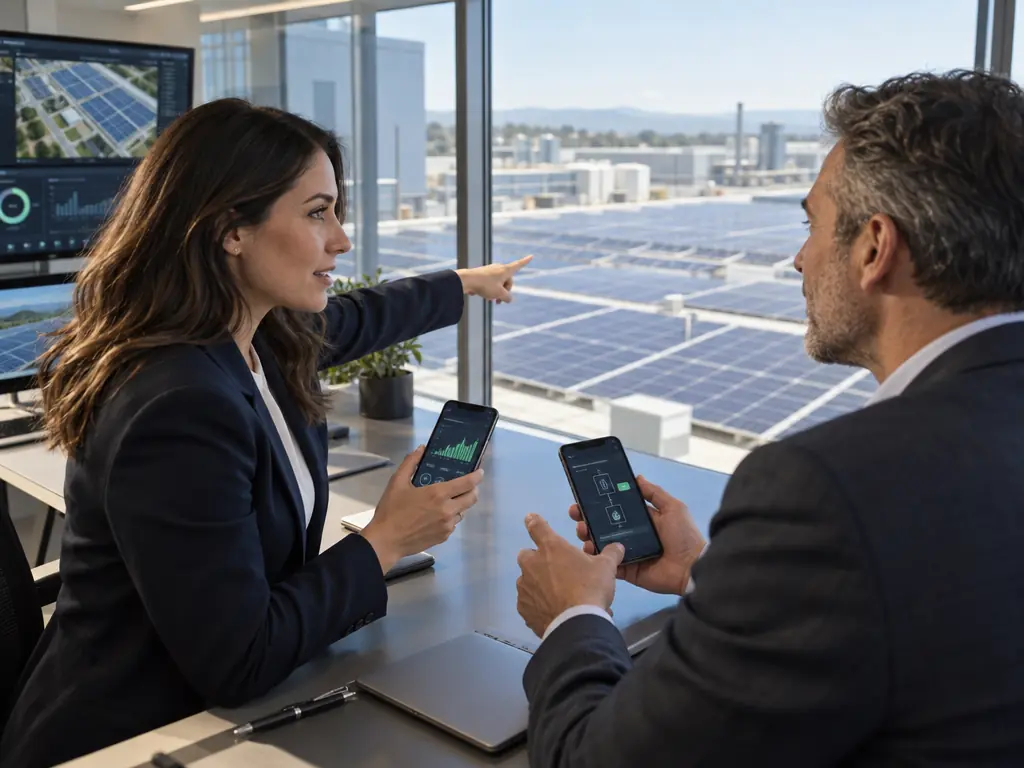
ICISolarOps delivers each plant's current generation output and daily energy yield to any mobile device, instantly. For organisations operating more than one site, total portfolio generation and the per-plant breakdown are visible on the same screen, giving the operations team a single source of truth across all facilities. Generation data is ingested via the plant SCADA system, inverter APIs, data loggers, or energy meters; the refresh frequency is configured to match the organisation's technical infrastructure and operational requirements.
03 Capabilities
Periodic Production Analysis and Performance Benchmarking
Understanding true generation performance requires going beyond a live reading. ICISolarOps presents daily, monthly, and annual production trends charted against historical averages. Through integration with forecast models or meteorological platforms that account for irradiance, temperature, plant capacity, and technical losses, expected generation is compared directly against actual output. Deviations are surfaced on the management dashboard, and performance degradation can be analysed as a long-term trend rather than only as an immediate alert.
Inverter and Field Equipment Management
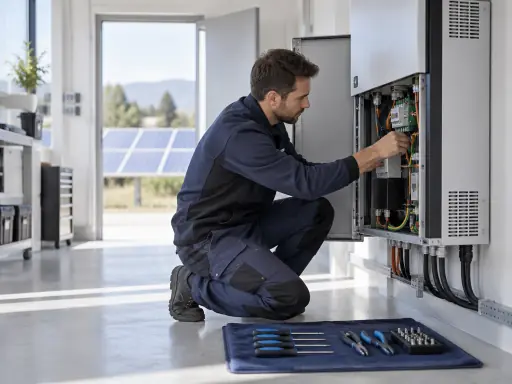
The operating status, fault codes, and performance values of every inverter on site are tracked within the mobile application. When a critical fault or generation loss occurs, the responsible technical team receives an immediate push notification. Transformers, meters, strings, and other field equipment can be added to the asset hierarchy to suit the organisation's requirements, allowing users to navigate from portfolio level down to individual equipment detail. Recurring faults are analysed on a per-asset basis and feed directly into preventive maintenance planning.
AI-Assisted Fault Detection and Operations Assistant
Machine-learning models analyse generation profiles, inverter data, and historical faults to surface anomalous behaviour. Performance differentials between comparable inverters, or recurring generation drops, are presented to the operations manager as inspection recommendations. Through an LLM-based mobile assistant, questions such as 'What appears to be the main cause of today's generation loss?' or 'Which inverters raised alarms in the last seven days?' can be asked in natural language; the AI generates a concise operational summary drawn from authorised data.
04 How it works
KPI Management, Revenue Forecasting, and Management Visibility
Technical KPIs including performance ratio, capacity factor, and availability are monitored on the mobile dashboard. KPI calculation methodology is defined at project inception in collaboration with the organisation's energy and technical teams, preventing conflicting results across different reports. Generation data can be mapped to the energy sale price or the organisation's financial model to produce daily, monthly, and annual estimated revenue indicators. AI-assisted forecast models use meteorological and historical generation data to provide short-term generation expectations, supporting financial planning and maintenance decisions.
Consolidated Management Across a Multi-Site Portfolio
For organisations operating more than one solar farm, sites can be compared by capacity, region, technology, or operating model. The management dashboard consolidates total portfolio generation, availability, performance ratio, alarm density, and estimated revenue. An AI-assisted daily summary surfaces the most significant generation deviations and equipment issues in a single view, while the technical team can drill into underlying detail at any time. The architecture is designed to scale from a single-site installation to a multi-country generation portfolio.
SCADA, CMMS, ERP, and BI Integration
ICISolarOps is not developed to operate in isolation from the organisation's existing infrastructure. It is built to integrate with the plant SCADA system, IoT platforms, computerised maintenance management system (CMMS), ERP, and BI tools. A critical inverter alarm can automatically raise a work order in the CMMS; generation data can be pushed to the BI platform or data warehouse. ERP integration supports maintenance cost tracking, contract management, and financial reporting. Field technicians can log a fault on site, attach photographs and notes, and record parts used, making the full cycle from alarm to resolution visible end to end.
Tailored to the Organisation: Not an Off-the-Shelf Product
ICISolarOps is not a standard monitoring application tied to a specific inverter brand. Every project is designed following analysis of plant topology, inverter manufacturers, SCADA infrastructure, meters, meteorological data, energy sale model, and the organisation's BI and ERP architecture. Plant hierarchy, mobile screens, KPI definitions, alarm thresholds, AI models, and integration points are configured on a per-project basis. This approach ensures the solution fits the organisation's actual operational conditions and existing systems precisely.
05 Same group
Other products
- Energy and Sustainability SolutionsICIEVCharge: An End-to-End EV Charging Platform Tailored to Your Organisation
- Energy and Sustainability SolutionsICIEnergyPulse: Making Facility Energy Consumption Visible and Manageable on Mobile
- Energy and Sustainability SolutionsICICarbonPulse: Turn Energy and Carbon Performance into a Daily Management Experience
- Energy and Sustainability SolutionsICISustainHub: A Sustainability and Carbon Management Platform Tailored to Holding Groups and Multi-Site Enterprises
06 FAQ
Frequently Asked Questions
01Is ICISolarOps only suitable for large energy companies?
Any energy investor or industrial organisation operating more than one solar site can benefit from the solution, regardless of portfolio scale. The system is configured to match the specific requirements of the organisation.
02Will it work with our existing SCADA system?
ICISolarOps is developed to integrate with the SCADA infrastructure an organisation already uses, so existing investment is preserved while operational data is consolidated into a single point of visibility.
03How quickly are alarm notifications delivered?
Anomalies detected on inverters or field equipment trigger notifications to authorised users as soon as they occur. Teams can assess the situation and prioritise a response before dispatching anyone to site.
04How does AI-assisted fault detection work?
The system continuously analyses generation and equipment data to identify potential faults at an early stage, surfacing inspection recommendations rather than waiting for a complete failure to occur.
05Can plants in different countries be monitored from a single screen?
The platform is designed for multi-site portfolio management and brings all facilities into a centralised view regardless of their geographic spread. Per-plant data can be analysed on a comparative basis across the portfolio.
06What data underpins the revenue forecasts?
Historical generation, meteorological data, and equipment performance coefficients are combined to produce forward-looking revenue projections for future periods. Operations and finance teams can use these forecasts as a decision-support input.
07Is the application developed entirely for our organisation?
Each engagement is designed from the outset around the organisation's operational structure, brand identity, and process requirements, producing a solution that belongs to the organisation rather than a pre-packaged product.
08Is integration with our ERP system possible?
A connection to the organisation's existing ERP infrastructure can be established to support processes such as work-order management and cost tracking, eliminating the gap between operational and financial data held in separate systems.
09On what basis are plants benchmarked against one another?
Industry-standard KPIs including capacity factor, specific yield, and target achievement rate can be used for periodic comparison across sites. The outputs are presented in formats suited to both the operations team and senior management.
10How long does deployment take?
Timescales vary with integration scope and the complexity of the organisation's infrastructure, so a dedicated roadmap is prepared for each project. icitech manages the full engagement from discovery through to go-live.
07 Contact